|
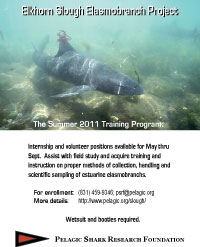
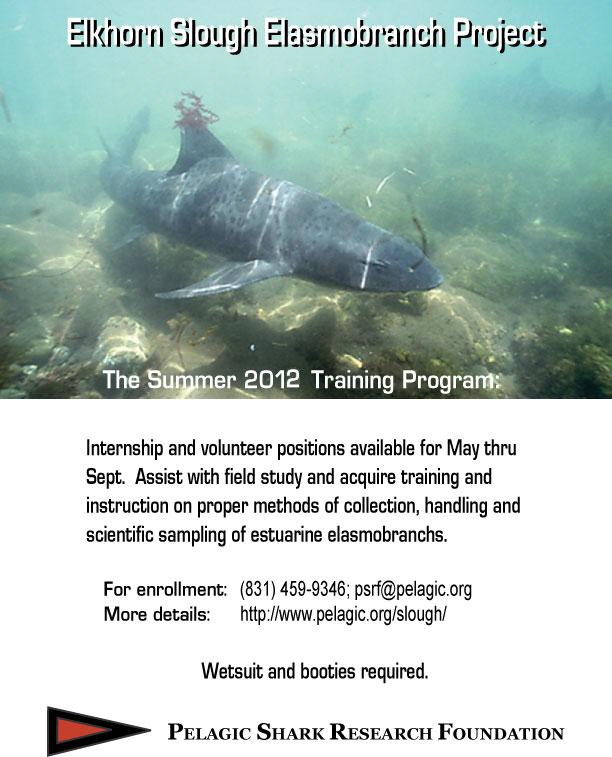
Elkhorn Slough Elasmobranch Project Field Course
Summer 2010 - Enrolling Now
Volunteer staff opportunities also available.

The PSRF has been offering exciting field courses beginning in the spring of each year since the early 1990’s. The aim of our field courses is to expand the understanding of elasmobranch communities for the purpose of education and conservation. Because they are key stone predators, elasmobranchs play a vital role in the health of estuarine and oceanic ecosystems. While much has been learned in recent years, many questions remain to be answered about these amazing creatures.

Overview
The general focus of our Elasmobranch Communities of Elkhorn Slough course portion is to allow students a chance to help with the study of the effect of tidal velocity and temperature on estuarine elasmobranch assemblages and abundances within the Elkhorn Slough National Estuarine Research Reserve (ESNERR) and other locations within the slough. PSRF has been assessing elasmobranch populations within Elkhorn Slough since 2002. Elkhorn Slough has been identified as a breeding/pupping area for leopard sharks as well as supporting a healthy population of shovelnosed guitar fish, California bat rays and thornback rays. Elkhorn Slough also experiences periods of expansion, brought on naturally by increased tidal flow. We are fortunate to be sampling during one of these periods, as such rare visitors to the slough such as a seven gill shark have been caught during sampling.
The Monterey Marine Canyon Pelagic Tagging segment allows students the opportunity to participate with our Pelagic Tagging Project. The project seeks to assess population dynamics and geographical range of pelagic species via mark and recapture. This information allows us to better determine which fisheries the sharks are making contact with and allowing for the creation of better management and conservation practices. Other project goals include the development of safer, less invasive sample methods. Our innovative no hook scoop-land-tag-release method has insured a record zero mortality rate for sampled blue sharks.
In Field Component
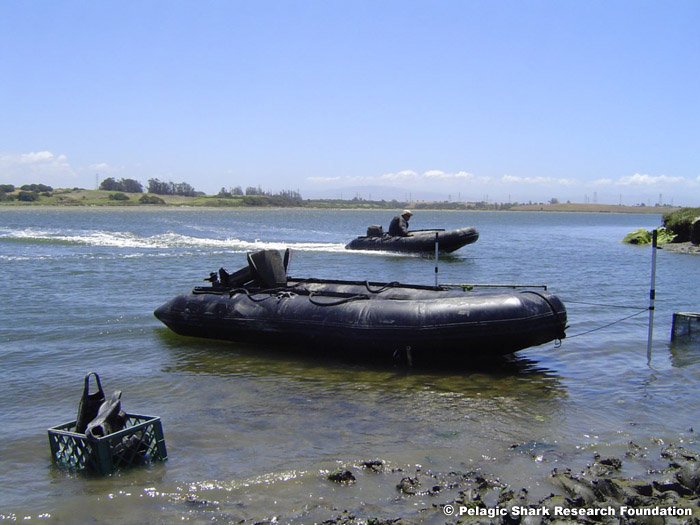
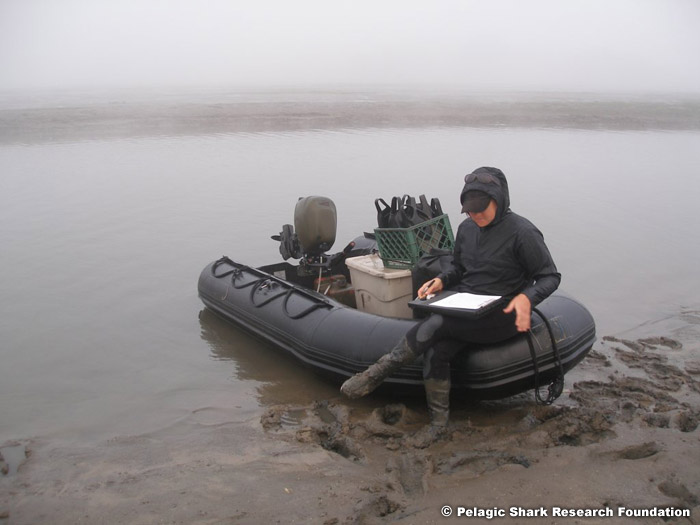
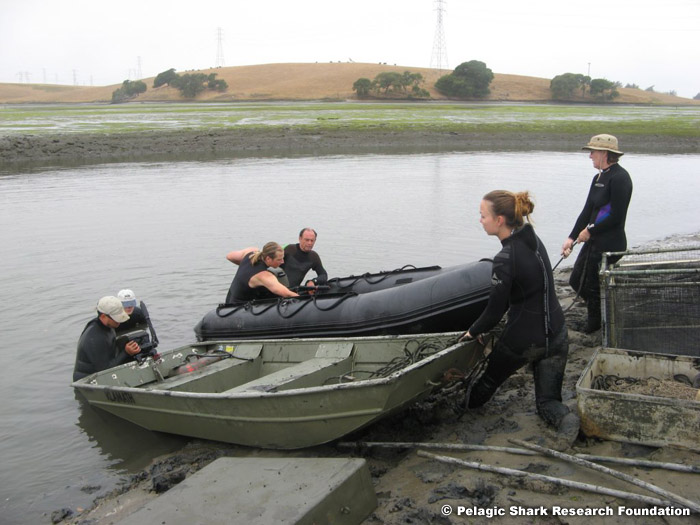
The in-field (hands on) course component familiarizes students with tagging, telemetry, field craft safety and use of capture equipment, as well as animal safety, transport and care. Students will practise live sampling methods such as walking with a beach seine net and capture by entanglement. Once captured, animals are quickly tagged and returned to the water. At PSRF we strive to accomplish overall animal and student safety. As such, we have achieved an excellent safety record and a low rate of animal mortality.
This part of the course occupies about 98% of total course time and takes place both in Elkhorn Slough and on Monterey Bay. This is also the most physically demanding portion of the course as there will be a need to swim short distances and lift field gear and animals. Students may also have the opportunity to learn photo ID methods and possibly scientific videography.
Other Components
Brief lectures will be given on the topics of biology, evolution, anatomy, behavior, migration, distribution, and ecology. Emphasis will be on sharks and rays found in the Monterey Bay area as well as on discoveries made by Pelagic.
As well, there will also be a short scientific drawing segment. We believe that doing detailed drawings helps in the learning process of distinguishing anatomical features between species as not all sharks and rays share the same body composition and dentition. Don’t worry, you don’t have to be an artist to participate in this segment.
Dissections
Periodically specimens are acquired from our Collecting/Stranding Response Unit, which also rescues and releases live sharks. If specimens are acquired students may have a chance to participate in dissections.
If no specimens are present for your course segment, we have plenty of high-definition photos of dissections that you may view.
Packages
Without Accommodations Package
With this package, participants provide their own accommodations, food and beverages. Participants will have to provide their own transportation to the field locations and to the chosen lecture locations.
With Accommodations Package
This package is the preferred choice for international participants and participants living long distances from research locations. This package is also perfect for those looking for convenience as PSRF provides 3 meals a day, beverages and transportation to and from research locations.
Course Dates
|
Start Date
|
End Date
|
With Housing
|
Without Housing
|
Field Location
|
|
April 4 2010
|
April 17 2010
|
$1600*
|
$500*
|
Slough
|
|
April 22 2010
|
May 5 2010
|
$1600*
|
$500*
|
Slough
|
|
May 10 2010
|
May 23 2010
|
$1600*
|
$500*
|
Slough
|
|
May 28 2010
|
June 10 2010
|
$1600*
|
$500*
|
Slough/Open Water†
|
|
June 15 2010
|
June 28 2010
|
$1600*
|
$500*
|
Slough/Open Water†
|
|
July 3 2010
|
July 16 2010
|
$1600*
|
$500*
|
Slough/Open Water†
|
|
July 21 2010
|
August 3 2010
|
$1600*
|
$500*
|
Slough/Open Water†
|
|
August 8 2010
|
August 21 2010
|
$1600*
|
$500*
|
Slough/Open Water†
|
|
August 26 2010
|
September 8 2010
|
$1600*
|
$500*
|
Slough/Open Water†
|
*
Excludes $200 USD fuel surcharge. Payments are due 40
days before the start date of each course. See briefing for payment options. †
Open water operations are weather dependent.
Specials
Our 20th anniversary special ! We our now reducing costs for the “with accommodations package”: from $1800 to $1600! * excluding fuel surcharge"
What’s Included
14 days/13 nights accommodation in a house at the Pajaro Dunes Colony. 3 meals per day prepared at the house, transport to and from Monterey/Carmel Airport, transport to and from field locations.
Prerequisites
No previous experience required
Must be comfortable working outdoors
Must be at least 18 years of age or over
Physical Requirements
Students must be fit and be capable of swimming for extended periods of time at the waters surface with/and without fins. Students should be capable of lifting up to 50 lbs and comfortable walking through muddy terrain. Students should also be tolerant of seasickness.
Equipment
Students are responsible for providing their own wetsuit and neoprene booties. Preference in wetsuit thickness varies between individuals, however water temperatures range between 50ºF to 60ºF. Students are encouraged to bring a laptop.
Certificate of Completion
Participants will be issued a signed certificate of completion once they have fully completed the course. (Attended every field session and lecture) This certificate acts as a reference and certifies that you have met the criteria necessary to perform basic elasmobranch field research.
Students wishing to join a field course will find detailed information about the course in the downloadable PDF Course Briefing below. Students are always welcome to inquire via email at: psrf@pelagic.org or phone at: (831) 459-9346.
Forms to be filled out before attending a field course are also available in the PDF Course Briefing. Forms are due 30 days before your course start date.
Download Flyer PDF 
Download Course Briefing (No Accommodations) PDF 
Download Course Briefing (With Accommodations) PDF 
|